LABOR DAY
As we honor all of us who labor, the story behind the fight to obtain this holiday is not widely known. The movement to honor the common working person began in the late 1800s, with the purpose to recognize the value of common working folks in society, as well as marking the beginning of the long struggle for the 8-hour work day.
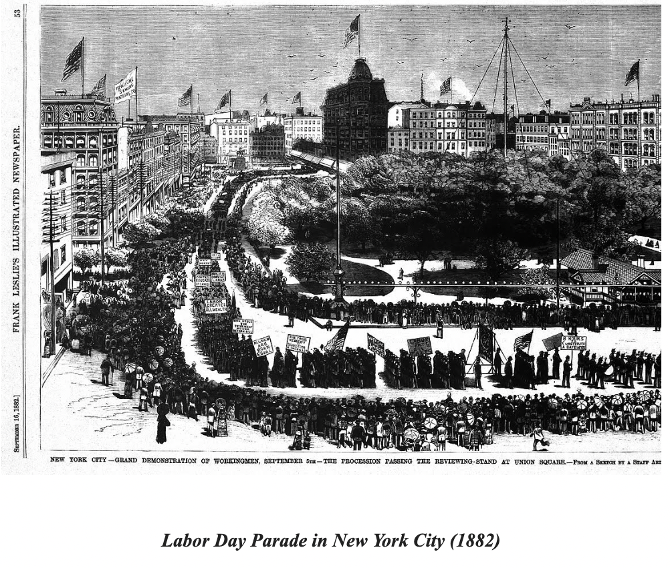
The very first Labor Day celebration is held in New York City on September 5, 1882. Organized by the Central Labor Union, roughly 10,000 workers march in an unpaid, voluntary parade from City Hall to Union Square to advocate for better working conditions, fair wages, and the implementation of an eight-hour workday.
The Haymarket Affair
May 1, 1886 was set as the target date by labor leaders for nationwide strikes and demonstrations. In Chicago—then a booming, highly industrialized city with fierce labor tensions—tens of thousands of workers walked off their jobs. Rallies were largely peaceful, but clashes with police, strikers and strikebreakers occurred over the following days.
Ironically, the non-union workers who were hired to replace the strikers were given an 8 hour work day!
On May 3, a crowd of striking workers outside the McCormick Reaper Works surged through the gates at exiting strike breakers, police arrived immediately - and without any attempt to disperse the crowd or use non-lethal crowd control - drew their revolvers and opened up direct, point blank fire into the workers - killing several. In response, labor organizers called for a mass protest rally the next evening.
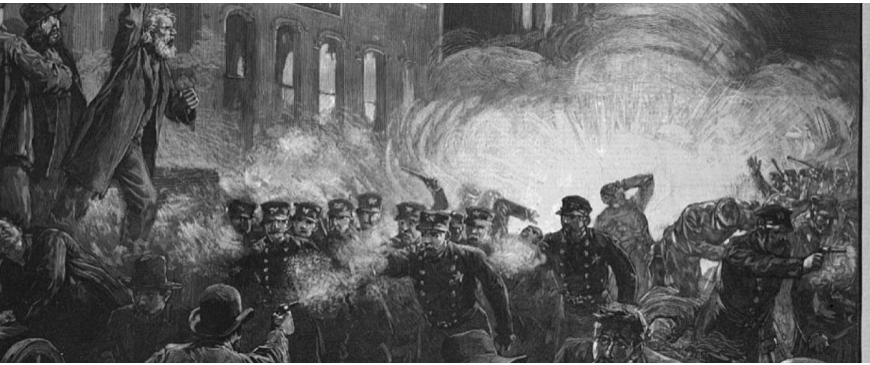
On May 4th, roughly 3,000 workers gathered at Haymarket Square in downtown Chicago. The speeches were relatively calm, and even the city's mayor, Carter Harrison Sr., attended and left, noting the crowd was peaceful. As the rally was winding down, an unidentified person hurled a crude, dynamite-filled pipe bomb from an alleyway into the police ranks.
Boom.
Several police officers & strikers were killed, with many who were wounded afraid to seek medical attention for fear of being arrested.
Eight union leaders were arrested for murder & trying to incite a riot - and despite lacking evidence - all eight were convicted, with four being executed, one committing suicide and the others sentenced to prison (in 1893, Illinois Governor John P. Altgeild pardoned the remaining three convicted men, citing the lack of evidence....and justice).
The public is outraged, as the bombing appeared to be what is today called a 'false flag' incident - an act of terror by a corporate & government alliance to have an excuse to squash a movement & arrest the organizers. The labor movement spreads nationwide, with Oregon becoming the first state to officially pass legislation recognizing Labor Day as a public holiday in 1887, followed by Colorado, New Jersey, New York, and Massachusetts.
The Pullman Strike
Driven by deep wage cuts during the severe economic depression following the economic Panic of 1893, approximately 250,000 railway workers walked off the job under the American Railway Union (ARU), led by Eugene V. Debs.
With the nation's rail network paralyzed in June, 1894 President Grover Cleveland ordered federal troops and U.S. Marshals into intervene, which turned volatile. Rioting broke out, rail yards were torched, and federal troops opened fire on crowds, resulting in more deaths of workers and widespread national outrage.
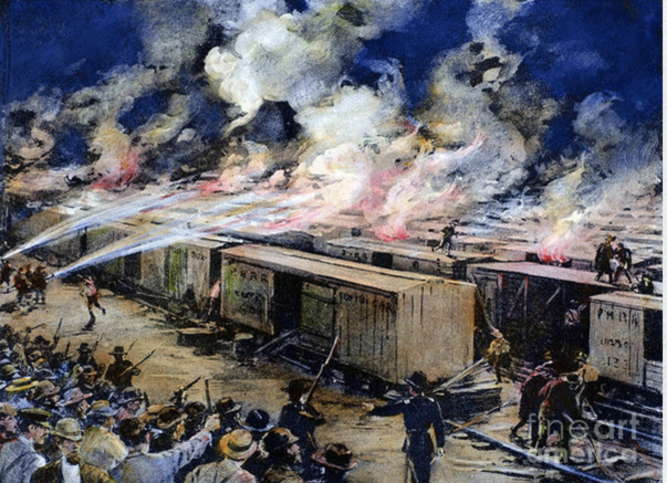
Burning Freight Cars - The Panhandle Railroad Yard - Chicago, Illinois
Colorized Drawing by Charles Mente from the original sketches by G.A. Coffin
Significantly,
organized labor and the public across the country were furious at Cleveland's Democratic administration for siding with a corporate monopoly over working-class survival, as their entire campaign revolved around appearing to support the workers and the growing labor movement.
With the mid-terms of 1894 coming up, Cleveland & congressional leaders had to scramble to appease millions of infuriated union members & voters without backing down on their anti-strike policies.
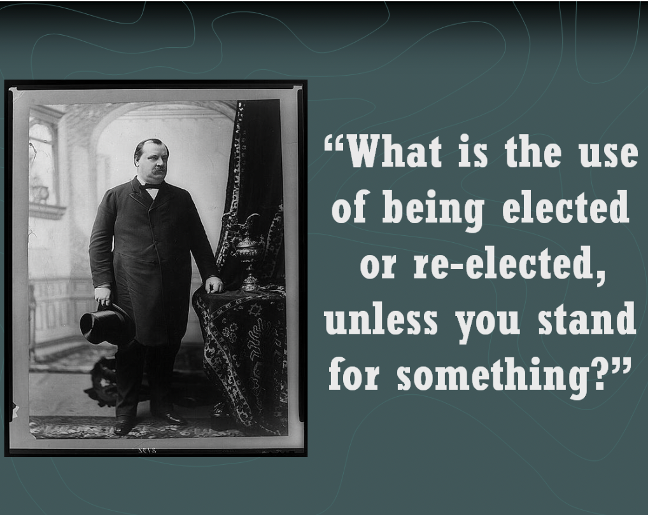
Bypassing the usual committee debates & skipping over much of the lawful processes to pass a law, Congress seized on the already popular grassroots concept of a "Labor Day" rapidly passing the bill so both party's politicians could go on the record voting FOR working people, just days after federal troops had killed striking workers in Chicago.
On July 6th, 1894, President Cleveland signed the bill into law, which cynically, is the same day Eugene V. Debs was indicted by a federal grand jury for conspiracy.
The creation of federal Labor Day was also born out of a profound contradiction. The holiday was signed into law by a president who had just crushed the most significant labor strike in American history by force.
Congress moved the official holiday from the unofficial May 1st to the first Monday in September, claiming the US needed a holiday between July 4th & Thanksgiving.
It was also convenient to have a new federal holiday a few months before the election.
A more sinister, deeper motive was moving this holiday to September in order to distance the holiday date from the Haymarket Affair - the event occurring in May that actually started the entire labor movement in the United States. The intentions of those behind the bill were to have the idea of Labor Day to be simply a day of ease, not a day commemorating the events and leaders who fought & died for better conditions of working people.
By changing the days was one way the true origins of Labor Day would fall into obscurity.
Which is why this article was written.
As we celebrate a holiday for all of us workers, let's also remember those who stood up, fought & died for an 8 hour work week, better working conditions, not just for having a holiday.